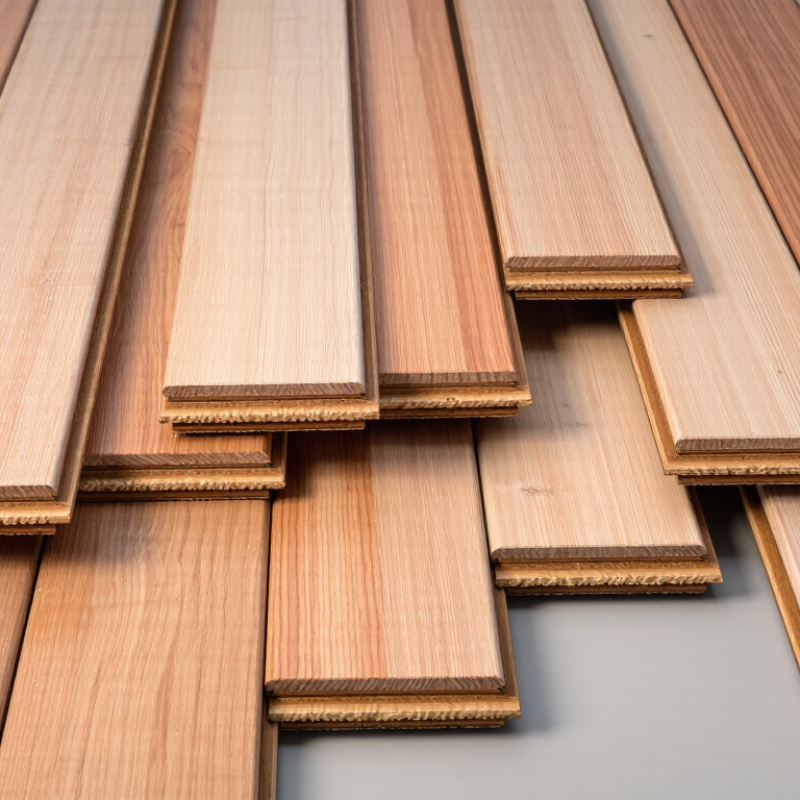
| Wear Layer | Approximately 2.5–4.0 mm of genuine maple wear layer for normal residential use; 3.5–4.0 mm or more for heavier traffic and possible refinishing. | Check the construction specification, cross-section photographs, and independent thickness measurement from a production sample. | A thicker maple layer provides greater service life and more potential for professional sanding and refinishing. | High priority |
| Total Board Thickness | Common engineered formats are approximately 12–20 mm thick. The selected thickness must match the subfloor, transitions, and installation system. | Measure finished board thickness at several points and compare it with the declared tolerance. | Thickness affects floor height, joint strength, acoustic performance, and compatibility with doors and adjoining floors. | Essential check |
| Core Construction | Multi-layer plywood or a balanced cross-laminated wood structure, with grain directions arranged to reduce movement. | Inspect a cut section for consistent layers, sound bonding, void-free construction, and uniform adhesive coverage. | Maple is a dense hardwood; a well-balanced core helps limit cupping, bowing, and joint stress caused by humidity changes. | High priority |
| Dimensional Stability | Require documented performance after humidity cycling, with no unacceptable delamination, open joints, buckling, or permanent distortion. | Review laboratory test reports using a recognized flooring or wood-panel test method and confirm the tested construction matches the supplied product. | Engineered flooring is generally more stable than solid wood, but installation moisture and poor core bonding can still cause failure. | Pass / fail |
| Moisture Content | Wood components should normally be conditioned close to the expected service environment; many flooring programs target roughly 6–9% at shipment, subject to climate and specification. | Use a calibrated moisture meter and sample multiple boards from different cartons. Compare results with the product specification. | Incorrect moisture content increases the risk of shrinkage, swelling, gapping, and installation problems after delivery. | High priority |
| Hardness and Dent Resistance | Hard maple is commonly reported at about 1,450 lbf on the Janka hardness scale, although the result depends on species, grading, moisture, and test method. | Confirm the declared maple species and review a laboratory hardness report or technical data sheet. | Hardness supports resistance to everyday indentation, but it does not replace a durable finish or correct installation. | Strong benefit |
| Surface Finish | Factory-applied UV-cured polyurethane, acrylic, or oil-based finish with consistent coverage and abrasion performance appropriate to the intended use. | Review the finish system, sheen consistency, abrasion or wear test results, edge coverage, and repair instructions. | Most visible wear occurs in the finish layer rather than in the maple itself; finish quality strongly affects maintenance requirements. | High priority |
| Formaldehyde Emissions | For wood-based panels, request compliance with the applicable destination-market limit, such as CARB Phase 2 or TSCA Title VI in the United States, or an applicable European emission classification. | Obtain a current third-party report identifying the product, production site, test method, and report date. Do not rely only on an unverified declaration. | Adhesives used in the core can affect indoor air quality. Emission performance must be assessed on the finished construction. | Mandatory |
| VOC and Indoor Air Quality | Prefer low-emitting coatings and adhesives supported by recognized indoor-air-quality testing for the intended market. | Request chamber-test data, coating safety documentation, and a complete list of regulated substances where available. | Low formaldehyde alone does not describe every possible emission from finishes, stains, primers, or adhesives. | Recommended |
| Timber Legality and Traceability | Documented legal sourcing, species identification, supplier traceability, and chain-of-custody evidence where certification is required. | Check invoices, species records, legality documents, certification numbers, and the consistency of documents across shipments. | Maple species and origin should be clear; traceability reduces the risk of substitution and supports responsible procurement. | Mandatory for responsible sourcing |
| Adhesive Bond Integrity | Continuous, well-cured bonding between the maple wear layer and the core, without visible gaps, bubbling, or weak edges. | Inspect cross-sections, perform delamination or bond-strength testing where appropriate, and review factory process controls. | Adhesive failure can cause hollow spots, face checking, delamination, and irreversible floor movement. | Pass / fail |
| Machining and Joint Precision | Consistent tongue-and-groove or click geometry, square ends, stable board width, and tight visual tolerances. | Measure sample boards from several cartons and conduct a dry-fit inspection before installation. | Accurate machining reduces gaps, uneven transitions, installation waste, and stress at the locking or glued joints. | High priority |
| Grading and Appearance | Define clear limits for knots, mineral streaks, color variation, sapwood, filled defects, edge defects, and face checking. | Approve a signed reference panel and inspect production against the agreed grading standard under consistent lighting. | Maple naturally varies in color and grain; a precise grade avoids disputes while preserving the material’s natural appearance. | Specify clearly |
| Installation Compatibility | Documented suitability for floating, glue-down, or nail-down installation, with subfloor flatness, moisture, and expansion requirements. | Review the installation manual and confirm compliance with the adhesive, underlayment, subfloor, and climate requirements. | Even a well-made floor can fail when installed over a damp or uneven subfloor or without the required expansion gaps. | Mandatory |
| Quality-Control Documentation | Batch traceability, inspection records, product tolerances, packaging controls, and corrective-action procedures. | Request inspection plans, sample reports, carton labels, and records that connect finished goods to production batches. | Consistent documentation is a practical indicator that technical claims can be verified and repeated across shipments. | Recommended |