How to Choose a Glass Shelf Brackets Supplier?
Choosing a Glass Shelf Brackets Supplier requires more than comparing catalogue prices. The decision affects safety, appearance, installation time, and customer trust. Grand View Research’s Glass Market Size report identifies continued growth in architectural and interior glass applications. This growth increases demand for dependable hardware, including brackets that support shelves in bathrooms, retail displays, offices, and homes.
Look closely.
A capable Glass Shelf Brackets Supplier should provide verified load ratings, compatible glass thicknesses, corrosion-resistant finishes, and clear installation instructions. Stainless steel, brass, and aluminum each behave differently in humid environments. A bracket may look strong on a sample board, yet fail when anchors, wall conditions, or glass tolerances are ignored. That practical gap matters. ASTM C1036 and related glazing standards can help buyers assess glass quality, although bracket performance also depends on the complete installation system.
Werner Sobek, a structural engineer associated with lightweight glass construction, has emphasized, “We have to build with less material.” His principle supports efficient design, but not careless reduction. The best supplier balances minimal visual bulk with tested strength. Reports from MarketsandMarkets on the construction glass sector also point to rising architectural demand and stronger expectations for product performance. Still, market statistics cannot replace physical testing. Ask for test evidence, batch consistency, finish samples, and technical support. Check whether the supplier can explain failure limits in plain English. That conversation may reveal more than a polished website. A cheaper bracket is not always economical. Sometimes, the overlooked washer decides everything.
Define Shelf Load, Span, and Glass Thickness Using 6–12 mm Industry Ranges
How to Choose a Glass Shelf Brackets Supplier?
Define Shelf Load, Span, and Glass Thickness Using 6–12 mm Industry Ranges
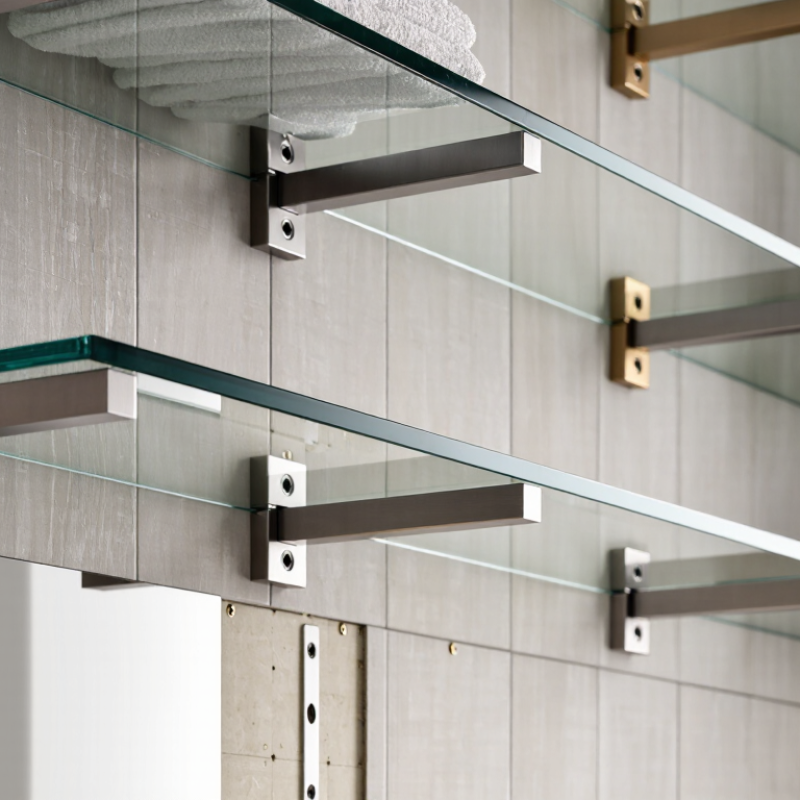
A reliable supplier should ask about shelf load, span, and glass thickness before suggesting brackets. A 6 mm glass shelf may suit light display items across a short span. A 12 mm shelf offers greater stiffness, but thickness alone does not confirm safety. The glass type, edge finish, support depth, and bracket spacing also matter.
Measure the clear span between brackets, not the total shelf length. For example, a 900 mm span carrying books creates more deflection than a 500 mm span holding small ornaments. State the expected load in kilograms and describe its position. A centered load behaves differently from weight placed near the front edge. Suppliers should provide load tables, installation guidance, and test information for the exact bracket design.
Ask whether the recommendation covers 6, 8, 10, or 12 mm glass. The bracket must grip the glass without point pressure or sharp contact. Protective liners and adjustable clamps can reduce local stress. Use compatible tempered or laminated glass as specified by a qualified professional. That shortcut is tempting. It is also incomplete. I once saw a shelf selected by thickness alone, while its long span caused noticeable sagging. Recheck the numbers before ordering, and request written limits for spacing, load, and mounting surfaces.
How to Choose a Glass Shelf Brackets Supplier? — Define Shelf Load, Span, and Glass Thickness Using 6–12 mm Industry Ranges
Important: The shelf dimensions above are example quotation scenarios, not universal safe-span limits. Glass capacity depends on glass type, dimensions, support positions, edge condition, loading pattern, and installation. Ask the supplier to assess the complete assembly and provide a load rating with its test conditions before specifying or installing a shelf.
Verify Tempered Glass Compatibility Under EN 12150 and ASTM C1048 Standards
How to Choose a Glass Shelf Brackets Supplier?
Tempered glass compatibility must be verified, not assumed. EN 12150-1 covers thermally toughened soda-lime silicate safety glass. ASTM C1048 covers heat-treated flat glass, including fully tempered and heat-strengthened types. These standards address glass performance, not every bracket design. A supplier should provide the glass specification, thickness, edge condition, and test records. Ask whether the bracket contact area suits tempered glass. Sharp pressure points can create local stress, even when the glass certificate looks correct.
The International Energy Agency’s 2023 Global Status Report for Buildings and Construction states that buildings consume about 30% of global final energy. That figure reinforces the value of durable interior systems, although energy data does not prove bracket safety. The weak point is often the interface. Request load testing with the exact bracket, pad, screw, and glass combination. Check working-load limits, safety factors, hole clearance, and edge distances. A supplier offering only a generic “tempered glass compatible” statement is not providing enough evidence. I would also question test results using a different glass thickness.
Tips: Match EN 12150 or ASTM C1048 documentation to the actual shelf. Confirm no drilling or cutting occurs after tempering. Use compliant pads between metal and glass. Require installation drawings and replacement guidance. Inspect every contact surface before fitting. Small defects matter. Supplier selection should include technical support, traceable batch records, and independent test evidence. A polished catalogue is useful, but it can still hide practical gaps.
Compare Bracket Load Ratings, Test Reports, and a Minimum 4:1 Safety Factor
Choosing a glass shelf brackets supplier requires more than comparing catalog prices. Begin with the working load, glass thickness, shelf depth, bracket spacing, and wall substrate. These details determine real performance. A bracket rated for 40 kilograms may not support that weight safely on plasterboard with weak anchors.
Ask suppliers for independent test reports, not only product brochures. Each report should identify the bracket model, material, mounting method, test setup, and failure load. Check whether the test used the same screws, wall type, and glass configuration as your project. Otherwise, the number may look precise but offer limited guidance.
Set a minimum 4:1 safety factor for the stated working load. For example, a 20-kilogram working load should withstand at least 80 kilograms under defined test conditions. This margin helps address uneven loading, occasional impact, and installation variation. It does not replace engineering judgment. Confirm whether the rating applies per bracket or to the complete shelf assembly. Also inspect corrosion resistance, weld quality, edge protection, and fastener compatibility. Some suppliers provide excellent reports but vague installation instructions. That is a warning sign. In practice, I would request a sample and check fit, movement, and screw seating before placing a large order. The sample may expose an assumption that the specification sheet missed.
Audit Supplier Materials: AISI 304/316 Stainless Steel and Corrosion Data
When choosing a glass shelf brackets supplier, begin with a material audit. Ask whether the brackets use AISI 304 or AISI 316 stainless steel. Do not accept “stainless steel” as a complete answer. Request mill certificates, heat numbers, and an independent material verification report. These records should match the batch delivered to your facility.
AISI 304 usually performs well in dry indoor rooms. AISI 316 offers stronger resistance to chlorides, humidity, and coastal air. It is not corrosion-proof. Ask for corrosion data linked to a recognized test method, exposure time, and sample condition.
Salt spray results can help compare batches, but they do not perfectly represent bathrooms or seaside buildings. Look for evidence of pitting, staining, and crevice corrosion. Small defects matter.
Inspect welds, cut edges, screw holes, and polished surfaces. Poor cleaning can leave iron particles behind. Ask whether the supplier uses passivation after fabrication and how the process is controlled.
A common audit mistake is trusting a certificate without checking production samples. One report may describe raw material, not the finished bracket. That gap needs attention. Suppliers should explain failure limits, maintenance needs, and test uncertainty in clear language. If answers remain vague, pause the purchase. Documentation is useful, but physical inspection still matters.
Evaluate Certifications, Quality Control, Lead Times, Warranty, and MOQ Terms
Choosing a glass shelf brackets supplier requires more than comparing catalog prices. Ask for evidence. Request current certifications, material declarations, and independent test reports relevant to your market. Check whether the documents identify the exact bracket model, not merely a product family. A credible supplier should explain load testing, corrosion resistance, and safety margins in clear language.
Quality control should be visible on the factory floor. Look for incoming material checks, dimensional inspections, surface-finish checks, and batch traceability. Ask how workers verify screw holes, clamp pressure, and protective pads before packing. In my experience, a small dimensional error can make a glass shelf sit unevenly.
Small details matter. A certificate cannot replace consistent production records, and this is where many buyers overlook risk.
Confirm lead times in writing, including sample approval, production, inspection, and shipping preparation. Ask what happens when a component is delayed. Warranty terms should state coverage, duration, exclusions, and the evidence required for a claim. Avoid vague promises. MOQ terms also deserve practical review: a low MOQ may carry higher unit costs, while a large MOQ can trap cash in slow-moving stock. Request trial quantities or mixed-model orders when possible. I have seen buyers focus on warranty length and miss replacement response time. That oversight is worth reconsidering. A supplier that answers difficult questions openly is usually easier to manage after delivery.