| 1 | Primary Glass Material | Most mass-produced red wine glasses use food-contact soda-lime silicate glass. Premium lines may use strengthened, crystal-style, or lead-free crystal glass. | Lead-free formulations are increasingly specified for tableware intended for international markets. | Material selection affects clarity, weight, durability, cost, and compliance requirements. |
| 2 | Manufacturing Method | The industry is divided between automatic machine-made production and manual or semi-manual production. | Machine-made lines support high repeatability; handmade lines support complex shapes, smaller batches, and decorative work. | The chosen process determines minimum order quantity, unit price, lead time, and consistency. |
| 3 | Product Construction | A standard stemmed wine glass consists of a bowl, stem, and foot. These parts may be formed as one piece or joined during production. | One-piece machine production generally emphasizes productivity; joined construction allows more design flexibility. | Construction affects joint strength, appearance, balance, and breakage risk. |
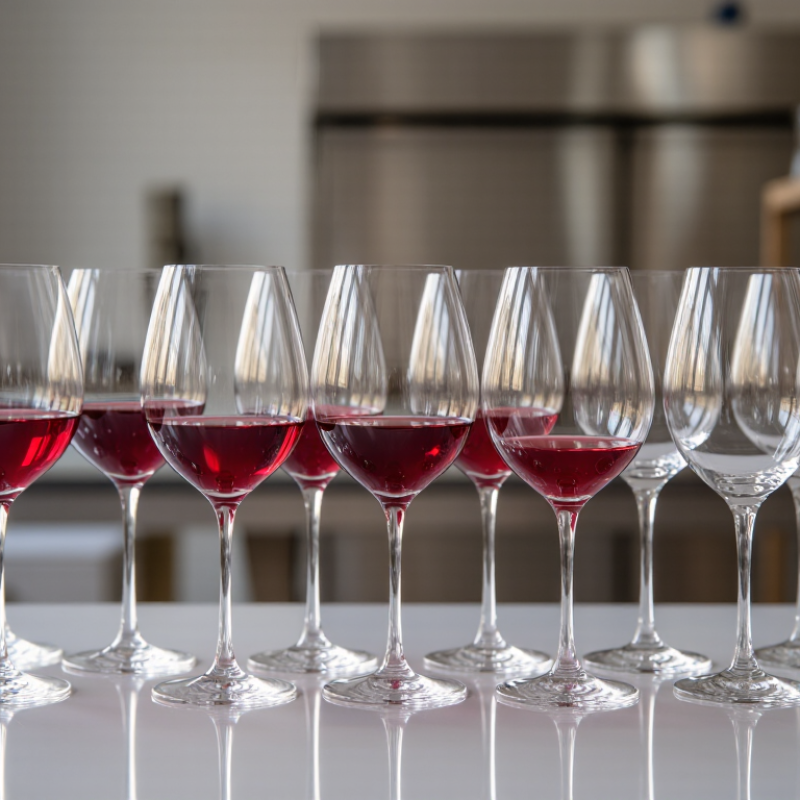
| 4 | Common Bowl Capacity | Red wine glasses manufactured for hospitality and retail markets commonly use medium-to-large bowl formats. | Typical nominal capacities are approximately 450–750 ml, with larger designs also available for specialist use. | Capacity influences product positioning, carton dimensions, shipping cost, and serving presentation. |
| 5 | Finishing Operations | Finishing may include rim fire-polishing, edge treatment, annealing, grinding, spraying, printing, frosting, and electroplating. | Clear, undecorated products are normally the simplest to scale; decoration adds process steps and inspection points. | Finishing affects mouthfeel, visual quality, scratch resistance, and production cost. |
| 6 | Thermal Processing | Annealing in a controlled lehr is a standard step used to reduce internal stress created during forming and cooling. | Thermal-shock performance depends on glass composition, wall thickness, forming quality, and annealing conditions. | A wine glass should not be described as heat-resistant unless the finished product has been specifically tested for that claim. |
| 7 | Quality-Control Points | Factories commonly inspect dimensions, rim condition, bubbles, stones, cords, inclusions, optical distortion, base stability, and breakage. | Inspection standards are usually agreed through approved samples, defect classifications, and an AQL-based inspection plan. | Clear acceptance criteria reduce disputes over cosmetic and functional defects. |
| 8 | Food-Contact Compliance | Export-oriented production typically evaluates glass composition, heavy-metal migration, coatings, inks, and other food-contact materials. | Relevant frameworks may include China’s GB 4806 food-contact standards, EU Regulation (EC) No. 1935/2004, and applicable destination-market rules. | Compliance must be confirmed for the complete finished product, including decoration and coatings. |
| 9 | Packaging and Logistics | Because stemware is fragile and space-intensive, manufacturers use dividers, molded pulp, foam, inner cartons, master cartons, and pallet protection. | Packaging validation normally includes drop, compression, vibration, and transit-risk assessments appropriate to the shipping route. | Packaging design can materially affect landed cost and damage rates. |
| 10 | Production Organization | China’s supply structure includes glass melting plants, stemware factories, decoration workshops, packaging suppliers, trading companies, and export distributors. | A single order may involve forming, annealing, decoration, inspection, and packing at separate or integrated production sites. | Buyers should identify which processes are performed in-house and which are subcontracted before approving a supplier. |