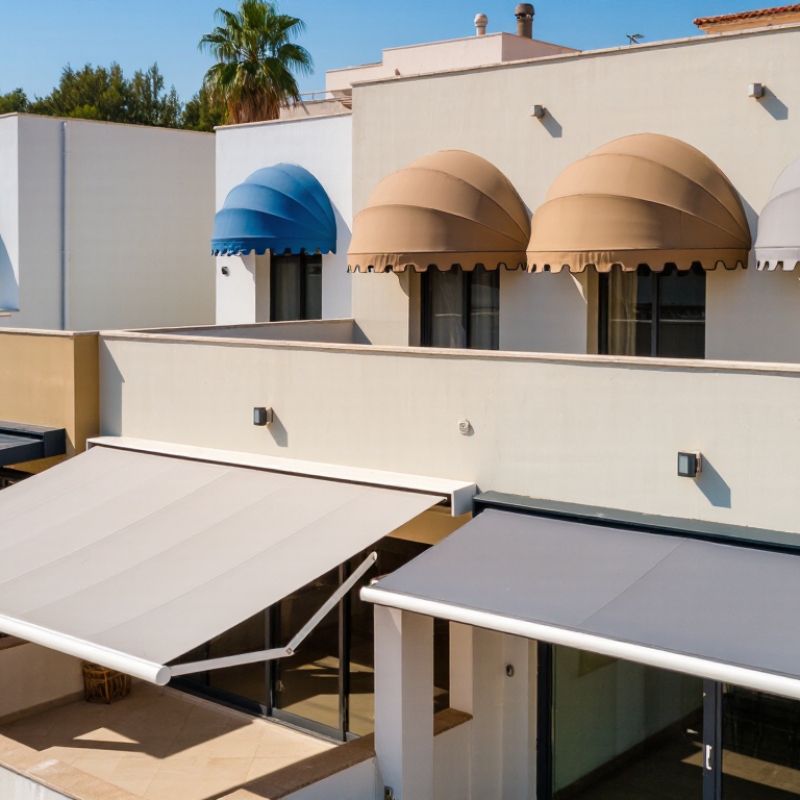
| 1 | Retractable Drop-Arm Awning | Fabric canopy supported by articulated folding arms; the fabric rolls onto a top tube when retracted. | Usually mounted above the window frame, on the wall, soffit, or a suitable structural surface. | Manual crank or motorized operation; optional sensors can help control sun and wind exposure. | Provides adjustable shade, preserves an open view when retracted, and can improve indoor solar control. | Moving arms and fabric require periodic inspection; extended fabric may be vulnerable to strong wind. | Homes and commercial windows where flexible shade control is important. | ★★★★★ |
| 2 | Fixed Frame Awning | Permanent fabric or metal-covered canopy stretched over a rigid frame. | Attached directly to the wall or window surround with fixed brackets and a supporting frame. | Stationary; it does not retract or adjust after installation. | Strong visual definition, dependable everyday shade, and relatively simple operation because there are no moving parts. | Shade angle cannot be changed, and the awning must be designed for the local wind and weather conditions. | Windows requiring continuous shading and a stable architectural appearance. | ★★★★☆ |
| 3 | Window Door Canopy Awning | Compact, shallow canopy with a projecting top plane, commonly using fabric, polycarbonate, or metal panels. | Mounted above a window or door with wall brackets, side supports, or a small frame. | Normally fixed; some fabric versions may use simple removable or folding supports. | Helps shelter glazing and entrances from rain while adding modest sun protection. | Offers less adjustable shade than a retractable system and may not cover wide windows effectively. | Entry doors, narrow windows, and locations needing basic weather protection. | ★★★★☆ |
| 4 | Dome Awning | Curved, semi-domed canopy that projects outward from the wall and often covers the sides of the window. | Fixed to the wall above the window using brackets or a shaped support frame. | Usually stationary; retractable dome versions are less common. | Provides distinctive decorative appeal and partial protection from overhead sun and light rain. | Curved construction can be more difficult to clean, repair, or replace than a flat canopy. | Bay windows, storefront-style windows, and façades where appearance is a major consideration. | ★★★★☆ |
| 5 | Quarter-Barrel Awning | Rounded quarter-cylinder profile with a curved roof and usually enclosed or framed sides. | Wall-mounted above the window with curved ribs or a custom support structure. | Generally fixed and non-adjustable. | Creates a strong curved profile and can provide good coverage across the top and sides of a window. | Uses more visual and structural volume than a flat awning and may be less suitable for very limited wall space. | Traditional façades, accent windows, and projects seeking a prominent architectural feature. | ★★★☆☆ |
| 6 | Waterfall Awning | Sloped or curved fabric design that falls downward from the top of the window, sometimes with a decorative scalloped edge. | Installed above the window using a top roller, fixed rail, or wall brackets. | May be fixed or manually retractable, depending on the frame and roller design. | Combines overhead shading with a decorative front drop and can reduce glare from low-angle sunlight. | The hanging front section can obstruct views and may move in windy conditions. | Windows needing stronger visual screening or a traditional decorative treatment. | ★★★☆☆ |
| 7 | Roller Window Awning | Flat fabric or mesh screen that rolls around a tube and extends vertically or at a slight outward angle. | Mounted above the window, inside a recess, or on the exterior face of the wall, depending on the system. | Manual chain, spring, crank, or motorized operation. | Compact when raised, offers precise coverage, and can be made with solar-screen fabrics for glare and heat control. | Exterior versions need suitable protection from wind; side gaps can allow some sunlight to enter. | Modern homes, offices, balconies, and windows requiring a clean, space-efficient shade. | ★★★★★ |
| 8 | Vertical Drop Awning | Screen-like panel that drops vertically along the outside of the window, sometimes with side tracks or guide wires. | Top-mounted above the window with side guides, cables, or retaining channels. | Manual pull, crank, spring-assisted, or motorized operation. | Effective for blocking low-angle sunlight, reducing glare, and improving privacy without a large outward projection. | Provides less overhead rain protection and may need secure guides in exposed locations. | West-facing windows, balconies, patios, and façades with limited projection space. | ★★★★★ |
| 9 | Louvered or Adjustable-Shutter Awning | Series of angled slats or louvers that can be fixed or adjusted to regulate light and airflow. | Hinged or framed to the wall, window surround, or side reveals. | Manual adjustment, folding, hinged opening, or motorized control in advanced installations. | Allows directional control of sunlight and can support ventilation while maintaining a degree of privacy. | More components may increase cleaning and maintenance needs; it may provide less fabric-like rain protection. | Hot climates, privacy-sensitive rooms, and windows where airflow is desirable. | ★★★★☆ |
| 10 | Retractable Side-Track Awning | Vertical fabric or mesh shade guided by side channels, tracks, or tensioned cables. | Mounted above the window with side tracks attached to the wall, frame, or surrounding structure. | Manual, spring-assisted, crank-operated, or motorized retraction. | Offers controlled shading and privacy, remains close to the wall, and performs better than free-hanging screens in moderate breezes. | Requires accurate installation and clear side-track alignment; not every system is designed for severe wind. | Large windows, outdoor rooms, balconies, and spaces needing both shade and privacy. | ★★★★★ |