| Product Coverage | Artificial football turf, shock pads, infill systems, goal areas, perimeter systems, and installation support. | A complete system must work as a coordinated surface rather than as isolated carpet components. | Whether the supplier can provide compatible turf, sub-base requirements, infill guidance, accessories, and installation documentation. |
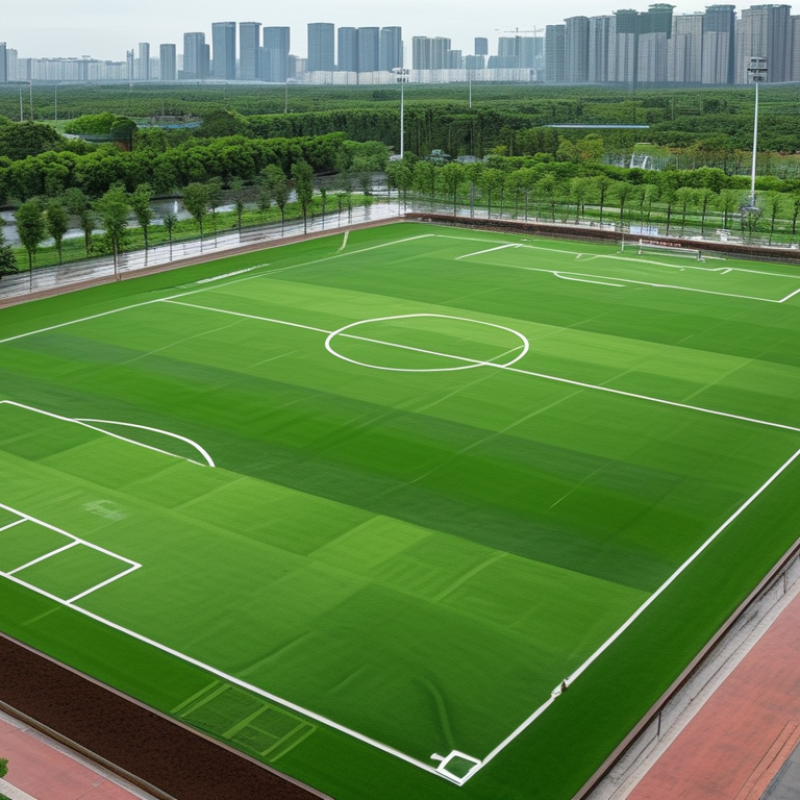
| Pitch Dimensions | Custom manufacturing and layout support for training pitches, community fields, and full-size football grounds. | Under the IFAB Laws of the Game, general field dimensions are 90–120 m long and 45–90 m wide; international matches use 100–110 m by 64–75 m. | The supplier’s ability to prepare accurate cutting plans, line layouts, seam maps, and material take-off calculations. |
| Turf Construction | UV-stabilized polyethylene yarn, reinforced backing, consistent tufting, and a documented drainage design. | Artificial sports surfaces are commonly assessed for durability, water permeability, interaction with the ball, and player-surface response. | Yarn profile, yarn weight, tuft density, backing composition, coating weight, drainage rate, and independent test results. |
| Pile Height and Density | Product options commonly fall within approximately 40–60 mm pile height, with density selected for the intended level of play. | Pile height and stitch density affect ball behavior, resilience, infill retention, appearance, and lifecycle performance. | The stated pile height, stitch rate, gauge, total mass, yarn thickness, and whether values are measured or nominal. |
| Safety Performance | Documented results for shock absorption, vertical deformation, rotational resistance, traction, and surface evenness. | These properties are central to player comfort, injury-risk management, and predictable movement on the field. | Recent laboratory reports showing the test method, sample construction, test date, and measured results for the proposed system. |
| Quality Standards | Products designed and tested against recognized sports-surface requirements, including EN 15330-1 where applicable. | EN 15330-1 specifies performance requirements for synthetic turf surfaces used for outdoor sports, including football applications. | The exact standard edition, applicable product scope, test laboratory, and whether the report covers the complete installed system. |
| Durability and Wear | Abrasion-resistant yarn, stable backing, secure seams, and maintenance instructions for high-use sports environments. | Wear depends on traffic volume, maintenance, climate, footwear, infill condition, and the quality of the complete installation. | Accelerated wear-test data, seam-strength results, UV-resistance evidence, expected usage level, and exclusions in the warranty. |
| Drainage Capability | Perforated backing and a drainage plan matched to the site’s sub-base, rainfall, slope, and underground drainage network. | Surface drainage performance is determined by both the turf and the engineered foundation beneath it. | Water-permeability results, drainage-layer specification, site drainage design, and required installation tolerances. |
| Climate Adaptability | Material selections suitable for the project’s UV exposure, rainfall, temperature range, humidity, and freeze-thaw conditions. | Outdoor synthetic turf performance can change with heat, moisture, ultraviolet radiation, and repeated seasonal expansion or contraction. | Regional references, UV-stability testing, backing behavior, infill temperature considerations, and maintenance recommendations. |
| Manufacturing Control | Traceable raw materials, batch inspection, production records, sample approval, and documented pre-shipment quality control. | Consistent yarn, backing, color, dimensions, and roll labeling reduce installation delays and field-to-field variation. | Factory inspection procedures, retained samples, lot numbers, inspection checklists, and corrective-action records. |
| Customization Capability | Custom colors, field markings, roll lengths, logos, line widths, and system configurations for different project requirements. | Custom elements must not compromise seam integrity, ball interaction, drainage, or safety performance. | Approved technical drawings, color samples, line-layout files, sample panels, and written confirmation of performance equivalence. |
| Installation Support | Technical manuals, seam instructions, sub-base guidance, site supervision options, and commissioning support. | Correct sub-base preparation, seam bonding, infill distribution, and surface leveling are essential to final performance. | Installer qualifications, method statements, inspection checkpoints, handover documents, and post-installation support. |
| Warranty Clarity | A clearly written product and installation warranty with defined service-life assumptions and maintenance obligations. | Warranty validity can depend on approved installation, cleaning, brushing, infill replenishment, usage intensity, and climate. | Coverage period, covered defects, usage limits, claim process, response time, remedies, and exclusions for improper maintenance. |
| Sustainability and End-of-Life Planning | Reduced material waste, responsible packaging, recyclable-content information, and a documented end-of-life approach. | Recycling feasibility depends on the composition and separation of yarn, backing, infill, shock pad, and adhesives. | Material declarations, packaging details, take-back or recycling options, and evidence supporting environmental claims. |
| Commercial Reliability | Clear quotations, realistic production schedules, export documentation, stable communication, and spare-material planning. | Project delays often arise from incomplete specifications, mismatched rolls, missing accessories, or unclear responsibilities. | Incoterms, packing lists, roll dimensions, lead-time assumptions, payment milestones, replacement policy, and project references without relying solely on price. |